





Human AI Operations: Fixing the Cost Problem in FinCrime
FinCrime costs rise because investigation effort increases with complexity, even when risk stays stable. Human AI Operations reduce cost by standardising preparation and execution, removing manual effort and enabling predictable capacity without changing detection or governance.
Financial crime compliance has a cost problem. Across institutions, spend continues to increase even when underlying risk remains relatively stable.
Teams expand, tooling improves, and detection becomes more precise, yet operational pressure does not ease.
The issue here is not a lack of investment. It is how that investment translates into execution, and this is where Human AI operations become relevant.
They introduce a different way to run financial crime operations by separating how work is executed from how decisions are governed.
In this blog, we explain why costs keep rising, where they actually accumulate, and how Human AI operations change the structure behind that trend.
Why do FinCrime costs keep rising even when risk stays stable?
Costs rise because the effort required to investigate risk continues to increase. Even in mature environments, additional investment has not resulted in proportional efficiency gains. This happens because:
- Detection systems generate more alerts across workflows
- Remaining cases require deeper analysis and stronger documentation
- Regulatory expectations increase the level of review required
As a result, effort per case grows over time. This creates an imbalance where operational cost increases faster than the underlying risk being managed.
- Read how SLA-based compliance addresses this challenge
Where does cost actually accumulate in FinCrime operations?
Cost accumulates before decisions are made, in the preparation and review of investigations. Analysts spend time gathering data across systems, interpreting behaviour, drafting structured explanations, reconstructing customer and transaction context.
This work is repeated across teams and cases, often without consistent structure. It leads to duplicated effort, inconsistent outputs, rework during review, and longer case cycles
Supervisory effort also increases, as more time is required to validate and correct investigations. This is the point where most operational costs are introduced.
Why doesn’t more investment solve the cost problem?
Institutions typically respond to rising cost pressure by hiring more analysts or adding tools. These actions increase capacity, but they do not change how work is performed.
Detection improvements reduce noise, but they concentrate complexity in the remaining cases. Analysts spend less time filtering alerts and more time reconstructing complex scenarios.
This creates a predictable cycle where fewer cases reach investigation, each case requires more effort, and workload shifts into preparation and review. Workload is redistributed rather than removed and without changing execution, cost continues to rise.
At this point, the issue becomes clear. Cost is driven by how investigations are executed, particularly in preparation and review. Addressing this requires a change in operating model rather than additional resources.
Human AI operations introduce that change.
The Solution: How do Human AI Operations change the cost structure of FinCrime?
Human AI Operations change how cost behaves in financial crime operations by reducing variability in execution. Instead of cost rising unpredictably with complexity, it becomes more stable and easier to plan because investigations are prepared in a consistent, structured way. AI gathers data, organises evidence, and drafts reasoning, while human investigators validate the work and make decisions.
Impact on cost structure
In traditional models, investigative effort varies case by case, driven by individual workflows, analyst experience, and the need for manual reconstruction. This creates uneven workloads, inconsistent outputs, and difficulty in forecasting capacity.
With Human AI Operations, execution is standardised. Similar cases require similar levels of work, reducing variability across teams and over time.
This shifts cost from reactive to predictable. Instead of increasing with every rise in complexity or volume, cost stabilises because the underlying work is structured. Capacity planning improves, and institutions can forecast workload and spend with greater confidence.
What changes in practice?
This shift changes the economics of FinCrime operations. When investigative preparation becomes consistent, the cost of handling cases becomes less dependent on individual analyst effort, case-by-case variation, and reactive hiring.
Over time, this makes cost per case more stable and capacity planning more reliable. Complexity still exists, but it no longer creates the same level of operational volatility because the underlying work is structured. Cost becomes easier to forecast, justify, and manage.
How do Human AI operations solve the FinCrime cost problem?
Human AI operations solve the cost problem by changing the part of the process where cost accumulates: preparation and review.
Instead of each investigation being manually reconstructed by analysts, preparation is standardised before review begins. Evidence is gathered, context is organised, reasoning is structured, and documentation follows consistent standards.
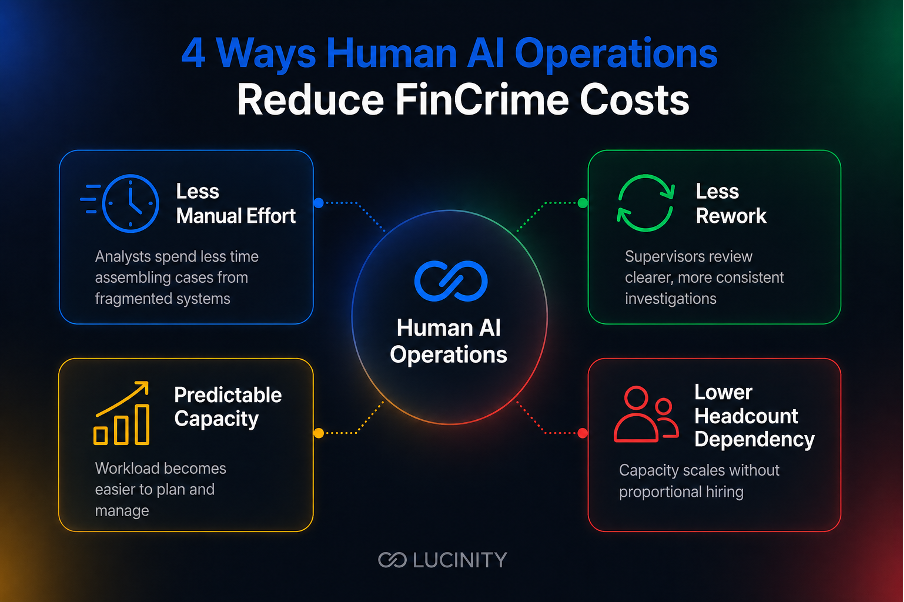
The Human AI approach reduces cost pressure in four ways:
Lower dependency on headcount: capacity can scale without proportional increases in internal teams
More predictable capacity: workload becomes easier to plan because preparation is structured
Less rework: supervisors receive clearer, more consistent investigations
Less manual effort: analysts spend less time assembling cases from fragmented systems
The institution still controls risk, thresholds, escalations, and regulatory decisions. Human AI operations reduce the operational effort required to prepare investigations, while governance remains where it belongs.
How does Lucinity deliver Human AI operations?
Lucinity delivers Human AI operations through Agentic FinCrime Services, running triage and investigation workloads under SLA inside the institution’s existing systems. Lucinity handles execution as a managed service and the institution retains governance.
The model covers L1 and L2 operations and follows a structured sequence:
- Alerts are generated by existing detection systems
- Investigations are structured through governed workflows
- Luci prepares evidence, reasoning, and documentation
- Human analysts validate and complete cases
- Institutions approve outcomes and retain accountability
- Learn more about Lucinity’s Human AI Operations
Final Thoughts
Rising FinCrime costs are driven by how investigations are executed, not just how risk is detected. As complexity increases, manual preparation and review introduce more effort into each case. Without changing that structure, cost continues to grow.
Human AI operations address this by standardising execution while leaving governance fully with the institution.
Key takeaways:
- cost grows faster than risk in current models
- preparation and review drive most operational effort
- adding resources does not remove structural inefficiency
- Human AI operations enable scalable execution with full control
For a deeper breakdown of the model and its impact, explore the full Human AI Operations guide: Download the guide now add link
Frequently Asked Questions
Why do FinCrime costs keep increasing even when risk stays stable?
FinCrime costs increase because each investigation requires more effort over time, including deeper analysis, stronger documentation, and more supervisory review.
Does better detection reduce compliance cost?
Better detection improves alert quality, but it often shifts effort to later investigation stages where cases require more context and documentation.
What drives most FinCrime operational cost?
Manual preparation and review drive much of the cost, as analysts gather data, reconstruct context, interpret behaviour, and document findings.
How do Human AI operations reduce FinCrime costs?
Human AI operations reduce cost by standardising preparation, reducing manual effort, limiting rework, and making capacity easier to scale.
Do Human AI operations change governance or decision-making?
No. Institutions retain control over risk definitions, thresholds, escalations, and regulatory decisions while execution is structured separately.
Looking to stabilise FinCrime costs without losing control?
Lucinity runs investigations under SLA while your institution retains governance and decision-making.
About the Author
Written by the Lucinity team. Lucinity is the Human AI company for financial crime operations, founded in Reykjavík in 2018. Its technology has supported AML, fraud, onboarding, sanctions, and ongoing monitoring in regulated environments for more than seven years.