




Human AI Operations: Why FinCrime’s Real Bottleneck Is Preparation
FinCrime inefficiency stems from manual investigation preparation, not detection. Standardising preparation through Human AI Operations reduces effort, improves consistency, and shifts investigators from reconstruction to decision-making, unlocking scalable capacity without changing governance.
Financial institutions have invested heavily in detection, and the results are visible.
Monitoring systems are more precise, alerting coverage has expanded across AML, fraud, sanctions, and customer lifecycle monitoring, and false positives have been reduced in many areas.
However, the operational pressure has still not reduced:
- Investigations take longer
- Workloads continue to rise
- Compliance costs are still difficult to control.
This blog explains why better detection has not translated into lower investigative effort.
You will see how the core bottleneck is not detection itself, but the preparation work that happens after alerts are generated.
You will also learn how Human AI operations help institutions reduce manual effort by up to 40%, improve consistency, and scale investigations while keeping governance and decisions under institutional control.
Why has better detection not reduced FinCrime workload?
Improved detection has not reduced fincrime workload as it only changes the shape of investigative work. As simpler alerts are filtered earlier, the remaining cases require deeper context, clearer explanations, and more complete documentation.
That creates a consistent operational pattern. Fewer alerts may reach investigators, yet each case takes more effort to complete. Analysts spend less time filtering noise and more time reconstructing complex customer and transaction behaviour.
From our work with financial institutions, we see this pattern repeatedly. Better detection increases the quality of alerts, but it can also concentrate complexity at later stages of review. Workload moves downstream into investigation preparation.
The origin and impact of the preparation bottleneck
The preparation bottleneck appears before judgment begins. It is the manual work required to make a case understandable, reviewable, and decision-ready.
Preparation includes gathering data across multiple systems, reconstructing context, interpreting behaviour, aligning findings with policy, and drafting narratives. This work is necessary, yet it is repetitive, inconsistent, and dependent on individual analysts.
This leads to familiar issues:
- Variation in output: similar cases are handled differently
- Rework: supervisors spend time correcting cases
- Long training cycles: knowledge is transferred informally
- Fragmented data: evidence sits across multiple systems
As complexity increases, preparation effort grows disproportionately. This is where much of the time, cost, and inconsistency is introduced.
It also constrains scale. More complex cases create more preparation work, so capacity does not increase predictably. Adding tools or headcount improves coverage, but it does not remove the underlying effort.
- Read more on the new operating model for FinCrime built for this problem
What happens when investigation preparation is standardised?
When investigation preparation is standardised, work no longer begins from raw alerts. Every case starts from a governed baseline where evidence is gathered, context is organised, reasoning is linked to source data, and documentation follows consistent standards.
How it is enforced
The baseline is enforced through the FinCrime OS, which defines what every investigation must include: required evidence, reasoning steps, workflow logic, and documentation aligned with institutional policy.
Required steps cannot be skipped, and every action is recorded in an immutable audit trail. Supervisors gain visibility into how investigations are prepared and progressed, making oversight clearer and review cycles faster.
What changes for investigators
This changes the role of the investigator. Instead of rebuilding context, investigators begin with a prepared view. Their role shifts to validating reasoning, applying judgment, and deciding what happens next.
The impact is operational and measurable:
- Reduced handling time: case handling time falls as manual reconstruction is removed
- Improved productivity: preparation becomes structured and repeatable
- Lower manual effort: organisations typically see a 20 to 40 percent reduction in manual investigative effort
These gains do not come from accelerating decisions. They come from removing unnecessary preparation work before the decision point.
Understanding Human AI operations in FinCrime
Human AI operations are a managed operating model where investigative work is prepared through structured workflows and explainable AI, then reviewed and completed by human investigators. The institution retains full control over governance, risk appetite, thresholds, escalations, SAR decisions, and regulatory accountability.
The model separates two areas that are often treated as one:
- Execution: how investigations are prepared, documented, and completed
- Governance: how risk is defined and final decisions are made
This separation matters because banks should define risk, not rebuild every investigation manually. Human AI operations change how work gets done without changing who owns the decision.
How do Human AI operations work?
Human AI Operations follow a structured execution sequence that ensures investigations are prepared before review while preserving full institutional control.
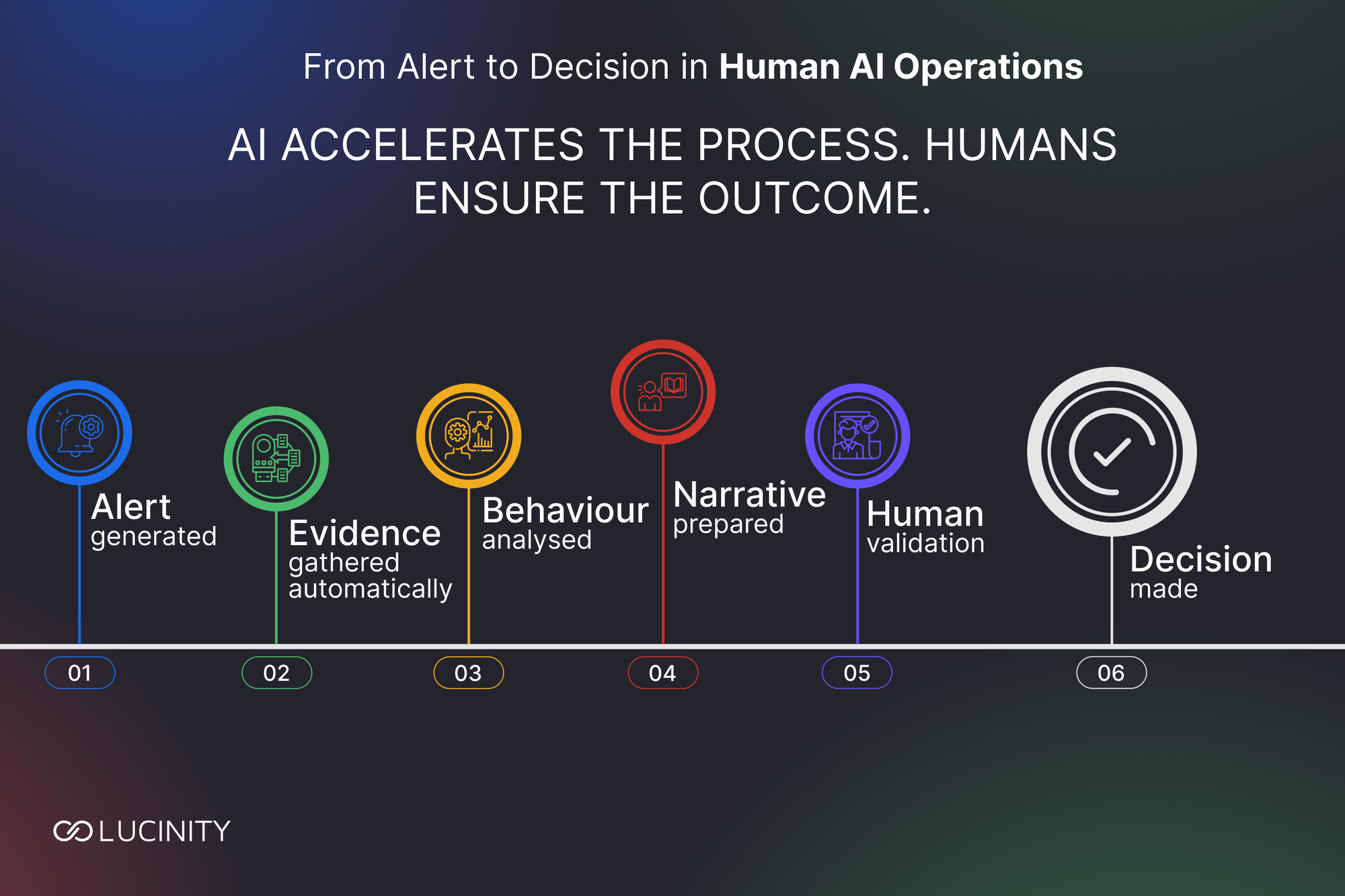
Step 1: Alerts are generated
Investigations begin with alerts generated by the institution’s existing detection systems. Detection rules, scenarios, and thresholds remain fully owned and unchanged.
Step 2: Investigation structure is enforced
A governed operating layer applies structure to the case. It defines required evidence, reasoning steps, workflow logic, and documentation standards aligned with institutional policy. Required steps cannot be skipped, and every action is captured in an audit trail.
Step 3: The investigation is prepared
Evidence is gathered and organised, behaviour is analysed in context, and reasoning is drafted in a clear, explainable format. Each explanation links back to source data and institutional policy.
Step 4: Human investigators validate and complete the case
Prepared investigations are reviewed by trained investigators. Reviewers and quality assurance leads support consistency, accuracy, and adherence to standards.
Step 5: The institution makes decisions
Approvals, escalations, and SAR filings remain with the institution. Governance, risk ownership, and regulatory accountability are unchanged.
Step 6: Cases are returned audit-ready
Completed investigations are delivered with structured documentation and full audit trails, ready for supervisory or regulatory review.
How does Lucinity deliver Human AI operations?
Lucinity delivers Human AI Operations through Agentic FinCrime Services. This means Lucinity runs triage and investigation workloads under SLA inside the client’s existing environment, covering both Level 1 triage and Level 2 investigation.
The delivery model has three parts:
FinCrime OS provides the structure
The FinCrime OS enforces institutional policy through structured, non-bypassable workflows. It defines how investigations should be prepared, what evidence is required, and how actions are logged for auditability.
Luci prepares the investigation
Within that structure, Luci gathers evidence, analyses behaviour, and structures reasoning in a clear, explainable format. Luci prepares the work; it does not make risk decisions.
Human experts complete the case
Lucinity’s managed workforce, including investigators, reviewers, quality assurance leads, and operational leads, validates and completes investigations to the institution’s standards.
The institution retains full control over governance, approvals, escalations, SAR filings, and regulatory accountability.
This model reduces workload without reducing control. Institutions benefit from faster investigation cycles, consistent and audit-ready outputs, improved cost-to-risk efficiency, and full continuity with existing systems and decision ownership.
The approach also supports supervisory expectations for transparency, explainability, human accountability, and auditability.
- Learn more about Lucinity Human AI Operations here.
Final Thoughts
Financial crime operations are not underperforming. They are operating within the limits of a model built around manual preparation. Detection will continue to improve, regulatory expectations will continue to rise, and investigation complexity will keep increasing.
Human AI operations address this bottleneck by separating execution from governance. Lucinity runs the operational workload, while institutions remain in control of risk, decisions, and regulatory accountability.
Key takeaways:
- Detection improvements shift workload unless preparation changes
- Manual preparation drives a large share of cost and inconsistency
- Standardised preparation allows investigators to focus on judgment
- Human AI operations scale execution while preserving control
For a deeper breakdown of the operating model, architecture, and real-world impact, explore the full Human AI Operations guide: Download The Guide guide link to be added
Frequently Asked Questions
What are Human AI operations in financial crime?
Human AI operations are a model where AI prepares investigations and human analysts validate the work, while institutions retain full control over governance and decisions.
Why is preparation the bottleneck in FinCrime investigations?
Preparation is the bottleneck because analysts spend significant time gathering data, rebuilding context, interpreting behaviour, and drafting narratives before making a decision.
Do Human AI operations replace compliance analysts?
Human AI operations do not replace compliance analysts. They reduce repetitive preparation work so analysts can focus on validation, judgment, oversight, and complex risk decisions.
How do Human AI operations reduce cost?
Human AI reduces cost by standardising preparation, reducing manual effort, improving productivity, and making capacity less dependent on headcount growth.
Does Lucinity change a bank’s detection rules or governance?
Lucinity does not replace detection systems or redefine risk. The institution retains control over rules, thresholds, policies, escalations, and SAR decisions.
Ready to reduce FinCrime workload without losing control?Lucinity runs investigations under SLA while your institution keeps governance and decisions.
About the Author
Written by the Lucinity team. Lucinity is the Human AI company for financial crime operations, founded in Reykjavík in 2018. Its technology has supported AML, fraud, onboarding, sanctions, and ongoing monitoring in regulated environments for more than seven years.