




Scale FinCrime Execution with Lucinity’s Human AI Operations
Lucinity delivers Human AI Operations as a managed execution layer, running investigations under SLA while institutions retain full control. Structured workflows, Human AI, and expert validation enable scalable, consistent, and audit-ready FinCrime operations without increasing internal complexity.
Financial crime operations today are not underperforming. Most institutions operate with strong governance, mature controls, and well-defined processes.
The challenge is sustainability.
Investigative work has become more complex to execute, documentation requirements have expanded, and supervisory expectations are more detailed. Over time, this has created sustained pressure on how investigations are performed.
Lucinity addresses this by taking responsibility for execution through Human AI Operations, allowing institutions to scale without increasing internal complexity. Let’s understand the challenge and how Lucinity solves it more closely.
The problem: Why does financial crime execution no longer scale predictably?
Financial crime execution no longer scales predictably because too much effort happens before judgment begins.
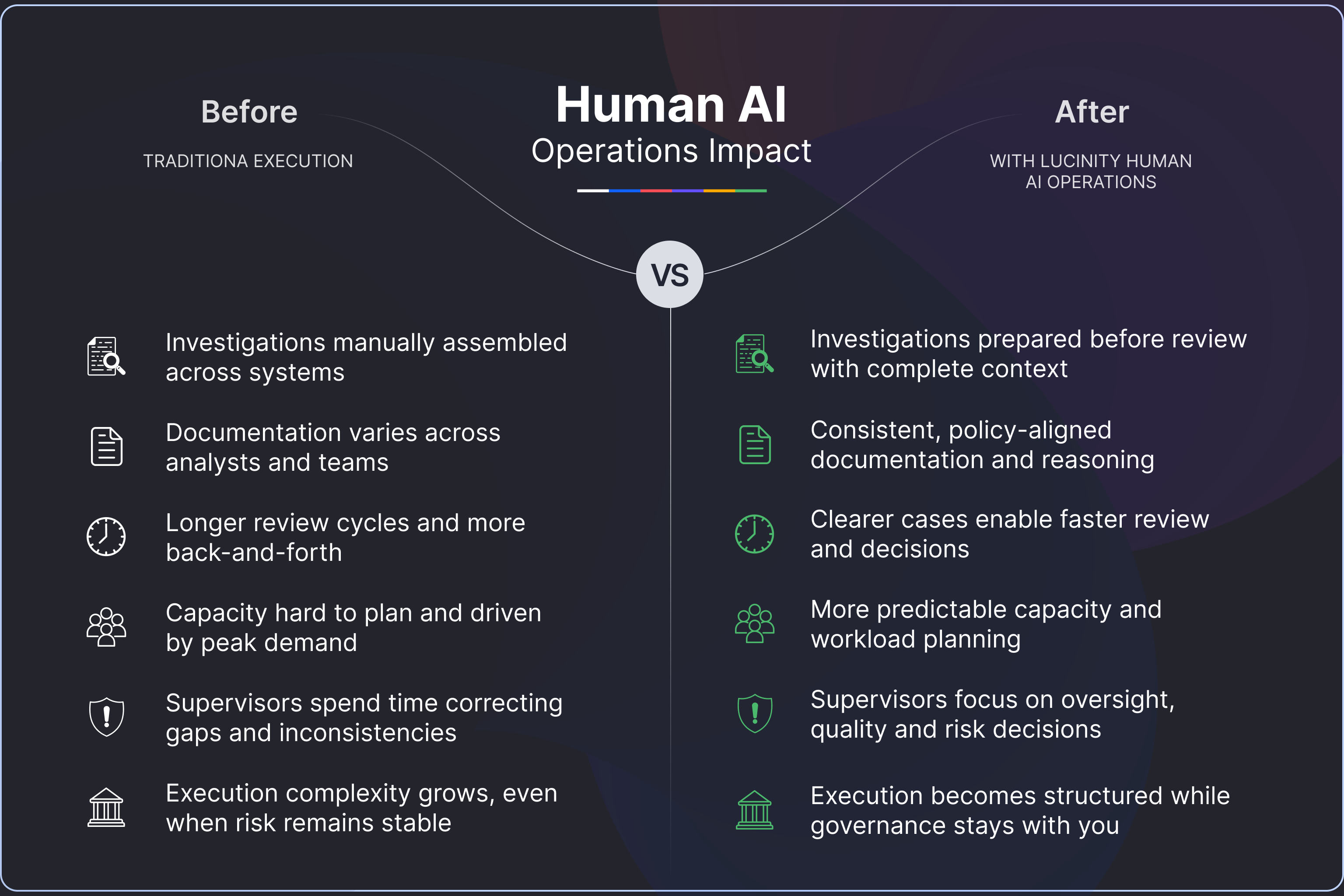
Analysts manually gather data, reconstruct customer and transaction context, interpret behaviour, and draft explanations. As complexity increases, this preparation work drives longer review cycles, more supervisory correction, and harder capacity planning.
Banks define risk differently, but most still duplicate the same case assembly work internally. The result is variable quality, rising cost, and growing operational effort even when risk levels remain stable.
Lucinity’s solution: Human AI Operations that separate execution from governance
Lucinity operates the execution layer of financial crime investigations as a managed service.
Through Human AI Operations, Lucinity runs triage and investigation workload across L1 and L2 under defined service levels for throughput, quality, and timeliness.
The institution retains full control over risk appetite, policy, detection rules, thresholds, escalation decisions, SAR filings, and regulatory accountability.
This separation is the core of the model: Lucinity executes investigations under SLA while the institution governs risk and decisions. By running preparation work centrally across institutions, Lucinity removes the duplication that drives variance and cost, while each institution's governance stays its own.
Institutions can scale capacity without transferring control by moving execution into a structured and managed model.
- Read more about transitioning to Lucinity’s managed AML services
How it works: How does Lucinity prepare investigations before review?
Lucinity delivers Human AI Operations through structured workflow, explainable AI, and managed execution. The FinCrime OS defines how investigations are prepared, including required evidence, reasoning steps, workflow logic, and documentation standards aligned with institutional policy.
These workflows are non-bypassable: required steps cannot be skipped, decisions are logged immutably, and supervisors have full visibility into case preparation and progress.
Within this structure, Luci gathers evidence, interprets behaviour in context, prepares explainable reasoning, and produces policy-aligned documentation. Luci does not make decisions; it prepares investigations so human reviewers begin with a complete understanding of the case.
The process follows a consistent sequence:
- Alerts are generated by existing detection systems
- Structured workflows define how the investigation is prepared
- Luci assembles evidence and reasoning
- Human investigators validate and complete the case
- Final decisions remain with the institution
Lucinity also operates a dedicated workforce of investigators, reviewers, QA teams, and operational leads to manage throughput, quality, and SLA performance.
Assurance and oversight: How does Lucinity keep execution safe and auditable?
Human AI Operations increase capacity without shifting risk or weakening oversight. Each prepared case includes source-linked conclusions, policy-aligned reasoning, contextual explanations, and a full audit trail, so supervisors can review how the case was assembled before judgment is applied.
Quality is managed through FinCrime OS standards, sampling, edge-case escalation, independent QA, and trend analysis. Calibration only affects how investigations are prepared, never detection rules, thresholds, or scenarios.
The model supports transparency, explainability, human accountability, and operational resilience while the institution retains full regulatory responsibility.
What changes and what does not: What does Lucinity improve without changing institutional control?
Lucinity changes how investigative work is executed. It does not change who owns risk.
What changes?
- Prepared investigations: Cases arrive ready for review instead of being manually reconstructed
- Consistent documentation: Outputs are structured and aligned with institutional policy
- Clearer review cycles: Cases are more complete, reducing back-and-forth
- Predictable capacity: Workload becomes easier to plan and less dependent on peak staffing
- Operational continuity: If service is interrupted, investigations can resume from a prepared state rather than raw alerts
What does not change?
- Risk ownership: Risk appetite and policy remain defined by the institution
- Detection control: Systems, rules, and thresholds remain unchanged
- Decision authority: Escalations and SAR filings stay internal
- Regulatory accountability: Full responsibility remains with the institution
- Data and workflow access: Data, workflows, and case history remain accessible to the institution at all times
A defined break-the-glass procedure also allows controlled access to the operational environment without migration or reconfiguration, supporting recovery in hours rather than weeks.
This distinction matters. Execution becomes structured and resilient, while governance remains fully institutional.
Adoption approach: How can institutions adopt Human AI Operations without replacing systems?
Human AI Operations are adopted incrementally, without replatforming or replacing existing systems.
Most institutions start with the Luci plugin inside existing review systems, preparing reasoning and documentation for selected case types without changing detection logic, alert routing, or infrastructure.
When ready, the FinCrime OS connects to alert feeds and data sources through standard integrations, then expands across additional case types, products, or regions based on internal priorities. Lucinity’s case management can be adopted later, but it is optional.
This keeps scope, pace, and governance under institutional control throughout the transition.
The final outcomes: What changes when Lucinity runs FinCrime execution under SLA?
When Lucinity runs execution under SLA, financial crime operations become more predictable, consistent, and scalable.
Investigations arrive prepared with structured evidence, clear explanations, and documentation aligned with institutional policy. Supervisors spend less time correcting gaps and more time on oversight, while internal teams focus on judgment, assurance, and higher-value risk work.
Institutions typically see a 20 to 40 percent reduction in manual investigative effort as preparation becomes standardised.
The broader impact is structural and extends beyond day-to-day operations:
- Cost predictability: Capacity becomes less reactive, and growth is no longer tightly coupled to alert volume
- Auditability: Consistent documentation reduces findings, remediation cycles, and supervisory friction
- Regulatory clarity: Reasoning is visible and policy application is traceable in practice
- Governance confidence: Predictable capacity and stable cost-to-risk ratios strengthen board-level and investor confidence
- Operational resilience: Centralised execution combined with continuity controls reduces dependency risk and improves response during stress events
This is the value of Human AI Operations: Lucinity runs the work, while institutions remain fully in control of risk, decisions, and accountability.
Final Thoughts
Financial crime operations are under pressure because investigative work has become more complex to execute, not because institutions lack capability.
Lucinity addresses this by running the execution layer through Human AI Operations. Investigations are prepared, structured, and delivered ready for review, allowing institutions to scale capacity while maintaining full control over governance.
Key takeaways:
- Operational pressure is driven by execution complexity
- Manual preparation limits scale and consistency
- Lucinity runs investigation workload under SLA
- Human AI Operations enable scalable execution without changing governance
Explore how Lucinity delivers Human AI Operations in our complete guide: Download the full guide add link
Frequently Asked Questions
Do Human AI Operations reduce institutional control?
No. Institutions retain full control over risk definitions, thresholds, escalations, and regulatory decisions while execution is handled separately.
How are decisions made in Human AI Operations?
Decisions remain with the institution. Human AI Operations prepare investigations, but final approvals, escalations, and SAR filings are made internally.
Is this the same as outsourcing FinCrime operations?
No. Unlike outsourcing, governance and decision-making do not move outside the institution. Only execution is structured and managed.
Do Human AI Operations require replacing existing systems?
No. The model operates within existing systems and workflows, introducing a structured execution layer without replatforming.
How do Human AI Operations improve auditability?
Human AI Operations improve auditability by ensuring investigations are consistently structured, with clear reasoning linked to evidence and policy.
Run FinCrime investigations without scaling internal teams Lucinity executes investigations while your institution retains full control.
About the Author
Written by the Lucinity team. Lucinity is the Human AI company for financial crime operations, founded in Reykjavík in 2018. Its technology has supported AML, fraud, onboarding, sanctions, and ongoing monitoring in regulated environments for more than seven years.