




How Irish Financial Institutions Can Prepare for the EU AML Package Without Expanding Compliance Teams
Learn how Managed AML Services help Irish financial institutions prepare for the EU AML Package without expanding compliance teams.
Preparing for the EU AML Package is becoming an operational challenge for many Irish financial institutions. As regulatory expectations increase, Managed AML Services are emerging as a practical way to strengthen compliance without continually expanding internal teams.
According to a recent EMEA AML Survey, 68% of Irish firms expect AML capacity needs to grow, yet only 40% believe they will be fully compliant by July 2027. In this blog, we’ll discuss what the new framework means, where the pressure points lie, and how institutions can prepare while keeping governance firmly under their control.
What Does the EU AML Package Mean for Irish Financial Institutions?
The EU AML Package is the most comprehensive reform of the European Union's anti-money laundering and counter-terrorist financing framework in last few years. Its objective is to create a single, more consistent regulatory framework across Member States while strengthening supervision and reducing differences in how AML rules are applied.
For Irish financial institutions, compliance will require more than updating internal policies. It will demand greater operational capacity to carry out customer due diligence, investigate alerts, document decisions, maintain audit-ready records, and respond consistently to regulatory expectations. Institutions that prepare early will be better placed to adapt without placing additional strain on their compliance teams.
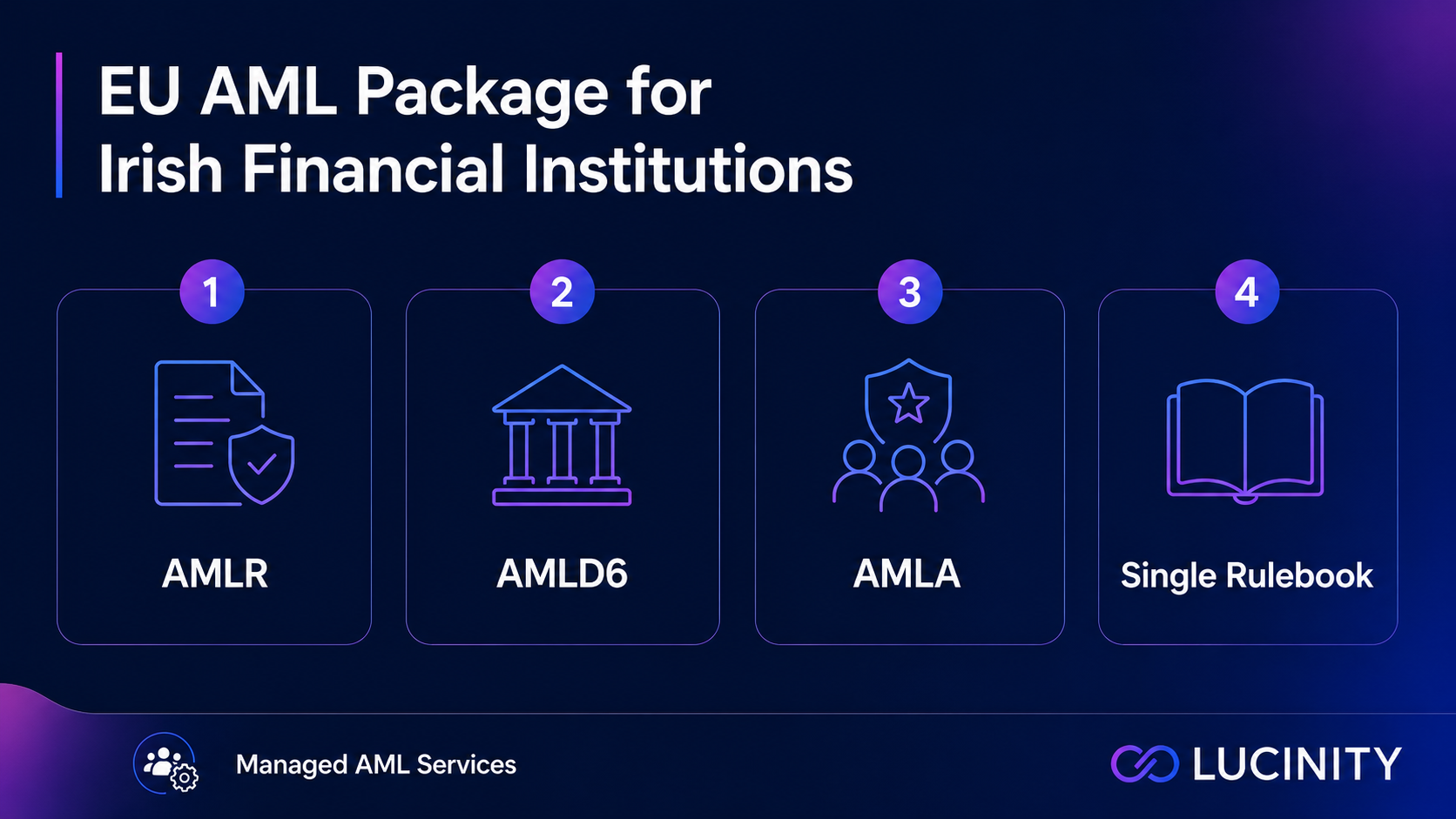
The legislative package consists of four interconnected measures that together transform the AML scenario.
1. Anti-Money Laundering Regulation (AMLR)
The Anti-Money Laundering Regulation introduces a directly applicable rulebook across the European Union. Unlike previous directives, many of its requirements will apply uniformly across Member States, reducing national differences in areas such as customer due diligence (CDD), beneficial ownership verification, internal controls, and record-keeping.
For Irish institutions operating across multiple jurisdictions, this greater consistency can simplify long-term compliance. In the short term, however, organisations will need to review existing processes to ensure they align with the new requirements before the regulation becomes applicable in July 2027.
2. Sixth Anti-Money Laundering Directive (AMLD6)
The Sixth Anti-Money Laundering Directive complements the regulation by strengthening how AML supervision is implemented at the national level. It clarifies the responsibilities of supervisory authorities and financial intelligence units while encouraging better cooperation between Member States.
As supervisory expectations become more aligned across Europe, institutions will face increased scrutiny over how their AML programmes operate in practice. Demonstrating consistent investigations, clear documentation, and effective governance will become just as important as having compliant policies.
3. Anti-Money Laundering Authority (AMLA)
A key element of the package is the establishment of the Anti-Money Laundering Authority (AMLA), the EU's new central supervisory authority for AML and CTF.
While the Central Bank of Ireland will remain the primary regulator for most Irish financial institutions, AMLA will coordinate supervisory standards across Europe and directly supervise selected high-risk cross-border institutions from 2028. Its role is expected to encourage higher consistency in supervisory expectations, making operational quality and audit readiness increasingly important for all regulated firms.
4. AML/CFT Single Rulebook Directive (AMLD6 Implementation and Scope)
In addition to strengthening supervision, the broader AML framework introduces clearer expectations around how institutions implement and evidence compliance across their operations. This includes enhanced requirements for risk assessments, internal controls, and reporting obligations.
For Irish financial institutions, this means aligning not only with the letter of the regulation and with how compliance is demonstrated in practice. Institutions will need to ensure that processes are consistently applied, decisions are well documented, and systems are capable of supporting increased transparency and auditability across all AML activities.
Why Will Compliance Teams Feel Heightened Pressure?
The EU AML Package is expected to increase operational demands across the entire compliance lifecycle. While many organisations already have mature AML frameworks in place, meeting higher regulatory expectations consistently will require more investigative capacity, stronger documentation, and greater operational resilience.
For many Irish financial institutions, the challenge is not in identifying FinCrime risks, it is having the resources to investigate and document them efficiently.
Customer Due Diligence Is Becoming More Resource Intensive
Customer Due Diligence (CDD) remains one of the most resource-intensive areas of AML compliance, and its difficulty is only increasing. Financial institutions must collect, verify, and periodically review customer information while applying enhanced scrutiny to higher-risk relationships.
Under the EU AML Package, institutions will need to demonstrate greater consistency in how these activities are performed and documented. This growing workload is shown in recent EMEA AML Survey, where 53% of Irish organisations said their current CDD processes remain overly rules-based, while 40% expect operational KYC effort to increase by at least 10% over the coming years.
Investigation Volumes Continue to Grow
Every alert generated by a transaction monitoring system creates work that extends well beyond an initial review. Analysts often need to consolidate information from multiple systems, assess transaction histories, perform open-source research, review customer profiles, prepare case narratives, and maintain a complete audit trail before reaching a conclusion.
As customer bases expand and payment volumes increase, the number of investigations rises accordingly. Even when detection technology improves, higher-quality monitoring often identifies more activity that requires human review. As a result, the operational workload continues to grow, even if detection becomes more effective.
Documentation Standards Are Becoming More Demanding
Regulators increasingly expect institutions to demonstrate that the correct decision was reached and how that decision was reached.
Each investigation therefore requires clear documentation supported by evidence, consistent reasoning, and a complete audit trail. This extends beyond suspicious activity reports to include customer due diligence records, internal reviews, quality assurance findings, escalation decisions, and ongoing monitoring activities.
Producing this level of documentation consistently takes time. As regulatory expectations increase, documentation often becomes one of the most significant contributors to overall case handling time.
Why Is Hiring More Analysts Not a Sustainable Response to the EU AML Package?
Hiring more analysts alone is unlikely to provide a sustainable response to the operational demands created by the EU AML Package. While additional staff can increase short-term capacity, rising compliance costs, recruitment challenges, and increasingly difficult investigations make this approach difficult to maintain over the long term.
The following factors explain why many Irish financial institutions are exploring more scalable operating models.
Why Does Recruiting AML Professionals Take Time?
Hiring experienced AML investigators has become increasingly difficult across Europe as demand for skilled professionals continues to exceed supply.
Even after recruitment, new analysts require onboarding, training, and time to become familiar with an institution's policies, risk appetite, investigation procedures, and technology. It may take several months before they contribute at full capacity, making recruitment a slower response to immediate operational pressures.
Why Can Larger Compliance Teams Become More Difficult to Manage?
Expanding a compliance team involves more than hiring additional analysts. Larger teams often require more supervisors, trainers, quality assurance specialists, and operational managers to maintain consistent standards.
As teams grow, maintaining consistency across investigations can become more challenging. Variations in documentation, investigative approaches, and review processes may increase case handling times instead of improving efficiency. Under the EU AML Package, maintaining consistent investigation quality is just as important as increasing capacity.
Why Do Compliance Costs Continue to Increase?
Expanding headcount has a direct financial impact. Recruitment, salaries, employee benefits, technology licences, training, and ongoing development all contribute to higher operating costs.
PwC's 2026 EMEA AML Survey found that around 30% of Irish financial institutions expect AML compliance costs to increase by between 10% and 30% as they prepare for the new regulatory framework. As a result, many institutions are looking for ways to strengthen operational capacity without allowing costs to rise at the same pace.
Why Doesn't Hiring More Analysts Always Improve Productivity?
AML investigations involve many manual tasks, including gathering information from multiple systems, validating customer data, reviewing transactions, documenting findings, preparing case narratives, and completing internal approvals.
When these activities remain largely manual, adding more analysts can only increase throughput to a certain extent. Over time, workflow efficiency, documentation quality, and investigation consistency become the primary problems. This is why many financial institutions are focusing on improving how compliance work is delivered rather than simply increasing the size of their teams.
How Can Irish Financial Institutions Prepare for the EU AML Package?
Preparing for the EU AML Package requires more than updating policies or meeting implementation deadlines. Financial institutions should assess whether their compliance operations can support increasing workloads while maintaining consistent investigation quality, documentation standards, and regulatory oversight.
A practical approach is to focus on strengthening operational resilience alongside regulatory compliance. This includes identifying where delays occur across AML processes such as customer due diligence, alert investigations, and periodic KYC reviews, and addressing capacity constraints in these areas.
Institutions should also prioritise consistent investigation practices, with clear documentation and structured case narratives that support regulatory scrutiny. At the same time, relying solely on hiring to meet rising demand is unlikely to be sustainable. More flexible operating models can help increase capacity without continual team expansion.
Finally, improving audit readiness is essential. Investigations should include clear reasoning, supporting evidence, and complete audit trails. Many institutions are also exploring Managed AML Services as a way to scale operations while maintaining governance and oversight, helping them adapt to long-term regulatory change without disrupting existing systems.
How Can Lucinity's Managed AML Services Help Irish Financial Institutions Prepare for the EU AML Package?
Preparing for the EU AML Package means handling more investigations, deeper due diligence, and stricter documentation. For many Irish financial institutions, the challenge is increasing capacity without constantly growing teams or overhauling existing systems.
Lucinity’s Managed AML Services help by taking on day-to-day investigation work under SLA. This allows internal teams to stay focused on oversight, decision-making, and regulatory responsibilities.
Lucinity supports tasks across the AML process, including CDD, EDD, alert triage, investigations, case documentation, quality checks, and SAR preparation. It works within existing systems, so institutions can strengthen operations without major changes to their setup.
Each investigation is supported by a combination of AI and human review, helping teams maintain clear documentation and consistent case handling. For institutions preparing for the EU AML Package, this approach offers a practical way to manage growing workloads while keeping control over compliance and governance.
Final Thoughts
For many Irish financial institutions, simply expanding teams is not sustainable. Managed AML Services provide a scalable way to increase capacity while maintaining control over policies, risk decisions, and regulatory accountability.
Lucinity supports this approach as a Human AI partner, running AML operations under SLA within your existing systems. By combining explainable AI with experienced investigators, we help accelerate investigations, improve consistency, and manage increasing workloads without disrupting current workflows.
- The EU AML Package increases operational expectations for customer due diligence, investigations, documentation, and governance.
- Hiring more analysts alone is unlikely to provide a sustainable long-term solution as compliance workloads continue to grow.
- Managed AML Services help financial institutions increase operational capacity while maintaining governance and regulatory accountability.
- Lucinity delivers AML operations under SLA inside existing systems, helping institutions improve investigation speed, consistency, and operational efficiency without disrupting current workflows.
To learn how your organisation can prepare for the EU AML Package, visit Lucinity today.
FAQs
1. What are Managed AML Services?
Managed AML Services provide operational support for anti-money laundering activities such as customer due diligence, investigations, alert triage, quality assurance, and case documentation. They help financial institutions increase compliance capacity while retaining responsibility for governance and regulatory decisions.
2. How can Managed AML Services help Irish financial institutions prepare for the EU AML Package?
Managed AML Services allow institutions to manage increasing compliance workloads without relying solely on additional hiring. They improve operational capacity, investigation consistency, and documentation quality while supporting regulatory readiness.
3. Do Managed AML Services replace a financial institution's compliance team?
No. Managed AML Services are designed to complement existing compliance functions. Institutions continue to set policies, approve escalations, and make regulatory decisions while operational activities are supported by specialist teams.
4. How does Lucinity support AML operations?
Lucinity operates as a Human AI partner that runs AML operations under SLA inside your existing systems. Explainable AI prepares investigations by gathering evidence and drafting structured case narratives, while experienced analysts complete cases according to your governance framework.
5. Will implementing Managed AML Services require replacing existing systems?
Not necessarily. Lucinity's Managed AML Services operate within your existing technology environment, allowing institutions to strengthen compliance operations without replatforming, major system changes, or disruption to established workflows.