




Why Instant Payments Require a New Approach to Transaction Monitoring in Europe
Discover why instant payments are changing transaction monitoring in Europe and how financial institutions can improve compliance.
Europe's payments ecosystem is changing rapidly. Instant payments are moving from a convenient option to an expected standard, supported by new regulation and growing customer demand for immediate fund transfers.
According to the European Central Bank (ECB), 2.47 billion instant payments were settled through TARGET Instant Payment Settlement (TIPS) in 2025, representing an 82.5% increase over the previous year.
Transactions that settle within seconds leave far less time to identify suspicious activity, investigate alerts, and intervene before funds move beyond recovery. This article explains why existing transaction monitoring approaches are increasingly challenged by Europe's instant payment environment and what a modern monitoring strategy should look like
Why are Instant Payments a Concern for Transaction Monitoring Experts in Europe?
For years, transaction monitoring programs were built around a relatively predictable payments environment. Most retail payments followed banking hours, settlement was not always immediate, and institutions could investigate suspicious activity before funds traveled far away from the originating account.
Monitoring strategies, operational workflows, and alert management processes evolved around these assumptions. Instant payments fundamentally alter that operating model. The first change is time. Under the SEPA Instant Credit Transfer scheme, payments are expected to be completed in around ten seconds.
Once a payment is executed, the opportunity to delay, review, or recover funds is significantly reduced. The second change is payment continuity. Instead of processing transactions during business hours or in scheduled settlement windows, banks now monitor activity around the clock.
A customer initiating multiple high-value transfers at 2 a.m. on a Sunday requires the same level of monitoring as one making payments on a Tuesday afternoon. This continuous operating model places greater demands on monitoring infrastructure and operational teams.
The third change is criminal behaviour. Financial criminals adapt quickly to payment innovations that reduce friction. Networks of mule accounts can distribute funds across multiple institutions within minutes, making it more difficult to reconstruct transaction flows after the event.
APP fraud has become particularly challenging because customers authorise the payment themselves, leaving institutions with little opportunity to intervene once the transfer is complete. Rather than relying on a single suspicious transaction, criminals increasingly fragment activity across accounts, payment channels, and jurisdictions to avoid triggering traditional detection thresholds.
Financial institutions are processing more low-value, high-frequency transactions alongside traditional retail and corporate payments. While most of this activity is entirely legitimate, distinguishing normal customer behaviour from emerging financial crime patterns becomes more difficult as payment ecosystems evolve.
Taken together, these changes create a different risk environment from the one many monitoring frameworks were originally designed to address. It is ensuring that transaction monitoring can operate effectively in a payment ecosystem that is continuous, high-volume, and increasingly difficult to assess using static monitoring approaches alone.
Why Existing Transaction Monitoring Models Were Designed for a Different Payment Environment
Many transaction monitoring frameworks in use today were built for a very different payments environment. Transactions were typically processed in batches, settlement often took hours or days, and compliance teams had valuable time to review alerts before funds were irreversibly transferred.
This operating model changed how monitoring programmes evolved. Detection relied on predefined scenarios based on historical transaction patterns, while investigations often took place in separate case management systems where analysts manually gathered customer information, transaction histories, and supporting evidence.
These foundations remain valuable, particularly because rule-based scenarios provide transparent and explainable controls that institutions can tailor to their own risk appetite. However, they were developed for a slower, more predictable payments ecosystem.
As instant payments become the norm, the challenge is not simply detecting suspicious transactions anymore. Institutions must also investigate alerts, document decisions, and respond at a pace that matches real-time payment activity.
What Are The Limitations of Existing Transaction Monitoring Method?
The principles behind traditional Transaction Monitoring remain relevant, but the environment has changed. Payment volumes continue to grow, customer behaviour evolves rapidly, and FinCrime techniques adapt just as quickly.
Several challenges are becoming increasingly common:
- Static rules require constant refinement. Rule-based scenarios remain essential, but thresholds based on historical behaviour require regular calibration to keep pace with changing transaction patterns and emerging financial crime typologies.
- More detection often means more alerts. Expanding monitoring coverage improves visibility, but it can also generate large numbers of false positives if investigation capacity does not grow alongside detection capabilities.
- Fragmented investigations slow response times. Analysts frequently need to collect information from multiple systems before assessing an alert, reducing throughput and extending investigation times as payment volumes increase.
- Regulators expect more than detection. Supervisors increasingly evaluate how alerts are investigated and documented. Clear reasoning, supporting evidence, and complete audit trails are now just as important as identifying suspicious activity.
Success of transaction monitoring increasingly depends on combining accurate monitoring with efficient investigations, consistent documentation, and operational capacity that can keep pace with Europe's real-time payments ecosystem.
How Should Transaction Monitoring Evolve for Instant Payments?
Addressing the limitations of traditional Transaction Monitoring does not require abandoning existing controls. Scenario-based monitoring remains the foundation of effective compliance because it provides transparent, configurable detection aligned with regulatory expectations.
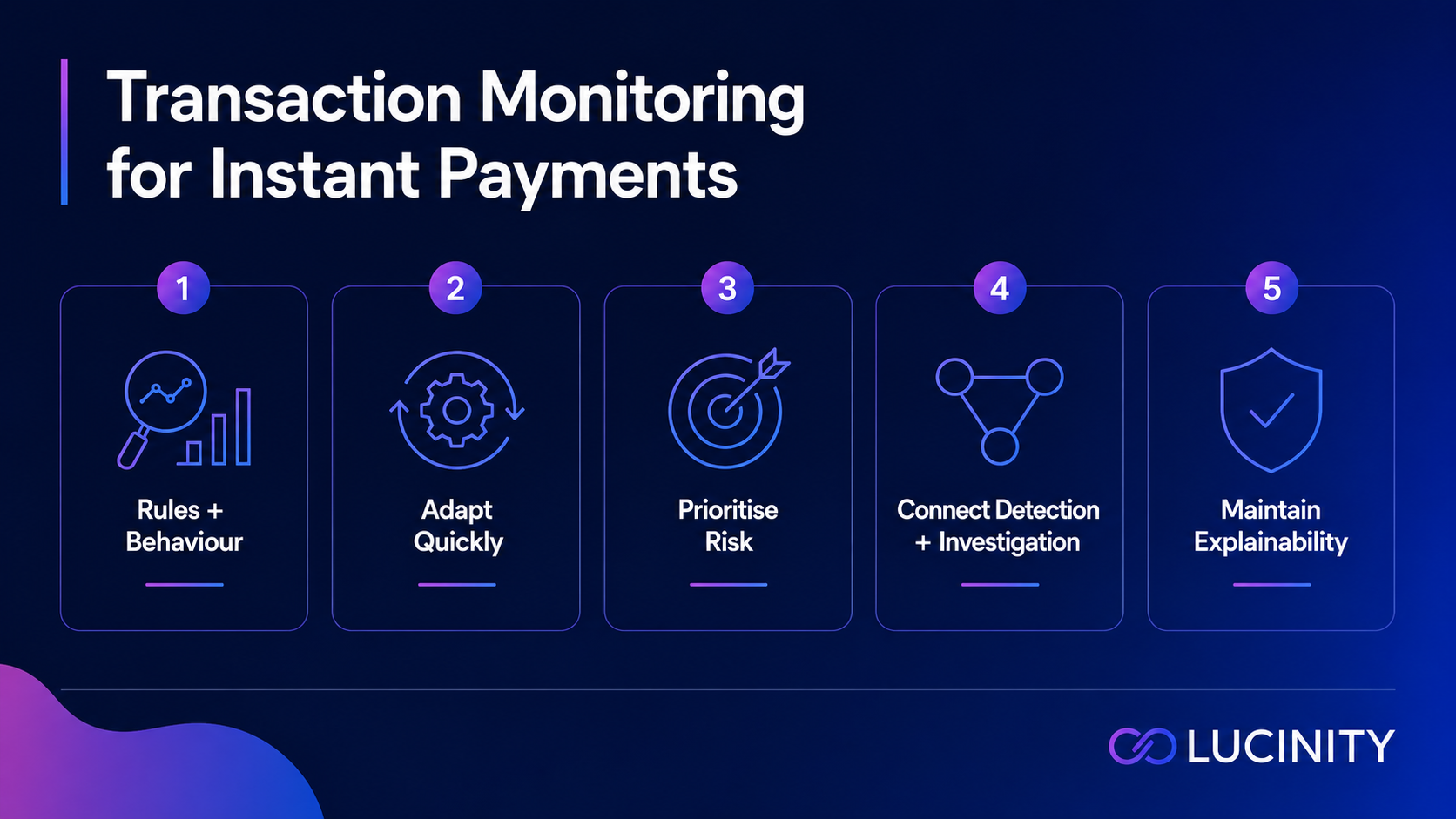
The difference is that instant payments demand monitoring frameworks that respond faster, adapt more easily, and support investigators throughout the entire case lifecycle. The following capabilities are becoming increasingly important as financial institutions modernise their monitoring programmes.
Combine Rules with Behavioural Intelligence
Scenario-based rules continue to identify many well-established financial crime typologies, from unusual transaction values to rapid movement of funds between accounts. However, modern financial crime often develops through subtle behavioural changes that may not trigger a single predefined rule.
Behavioural analytics complements rule-based monitoring by identifying patterns that emerge over time, such as gradual changes in transaction activity, changes in customer behaviour, or relationships between accounts that warrant closer investigation. Together, these approaches provide broader coverage while preserving explainability and institutional control.
Build Monitoring That Can Adapt Quickly
Payment behaviour, fraud techniques, and regulatory expectations continue to evolve. Monitoring frameworks that depend on lengthy development cycles can find it difficult to keep pace with these changes.
Modern platforms increasingly provide configurable scenario management, allowing compliance teams to create, refine, and back-test detection rules without extensive technical intervention. This enables institutions to respond more quickly to emerging risks while maintaining consistent governance over their monitoring framework.
Prioritise the Highest-Risk Alerts
As transaction volumes increase, reviewing every alert with the same level of effort becomes increasingly difficult. The objective is not to generate more alerts, but to ensure investigators focus on those most likely to indicate genuine FinCrime.
Risk-based prioritisation enriches alerts with customer information, historical behaviour, and contextual risk indicators before an investigation begins. This allows analysts to spend less time gathering information and more time assessing whether suspicious activity requires escalation.
Connect Detection and Investigation
Detection is only the first stage of the investigation process. Analysts still need to review customer profiles, transaction histories, sanctions results, KYC records, and previous cases before reaching a conclusion.
Bringing these activities together within a single investigation workflow reduces manual effort, improves consistency, and shortens investigation times. As instant payments continue to compress response windows, reducing friction between detection and investigation becomes increasingly valuable.
Maintain Explainability Throughout the Process
Greater analytical capability should never come at the expense of transparency. Regulators increasingly expect institutions to demonstrate that suspicious activity was identified, and how every investigative decision was reached.
Modern transaction monitoring should therefore produce clear reasoning, documented evidence, and complete audit trails throughout the investigation lifecycle. Explainability strengthens governance, supports regulatory reviews, and gives investigators confidence that every conclusion can be understood, challenged, and defended when required.
How Lucinity Supports Modern Transaction Monitoring?
Modern transaction monitoring requires more than stronger detection models. Financial institutions also need the operational capacity to investigate alerts quickly, document decisions consistently, and maintain regulatory confidence as payment volumes continue to grow.
This is where Lucinity takes a different approach. Rather than operating solely as a software provider, Lucinity acts as a Human AI operational partner that runs financial crime operations under SLA inside a client's existing environment.
Institutions retain full control of governance, thresholds, escalation policies, and regulatory decisions, while Lucinity helps accelerate the operational work required to investigate alerts and prepare cases.
For organisations that manage transaction monitoring internally, Lucinity's transaction monitoring platform combines configurable scenario-based detection with AI-supported monitoring, allowing institutions to build, test, and refine monitoring strategies without disrupting existing workflows.
Detection can be enhanced through behavioural analytics and integrated monitoring signals while remaining fully explainable and configurable to each institution's risk appetite.
Once an alert is generated, Lucinity's Human AI Platform helps investigators move from detection to decision more efficiently. Luci prepares investigation-ready cases by gathering evidence, analysing transaction behaviour, summarising customer activity, and drafting structured case narratives.
Human investigators remain responsible for reviewing the evidence, making decisions, approving escalations, and filing Suspicious Activity Reports where required. Every AI-assisted action remains visible, reviewable, and supported by a complete audit trail.
This operational model helps financial institutions reduce investigation times from approximately 2.5 hours to around 30 minutes, improve analyst productivity by up to 90%, and lower operating costs by 60-80% through Human AI Operations.
Wrapping Up
Instant payments are fundamentally changing how money moves across Europe. As settlement speeds accelerate and transaction volumes continue to grow, financial institutions need transaction monitoring programmes that combine effective detection with efficient investigations, transparent decision-making, and operational scalability.
Modern transaction monitoring is not defined solely by the number of scenarios an institution deploys. Success increasingly depends on how quickly investigators can assess alerts, access relevant information, document their reasoning, and respond with confidence while maintaining full regulatory monitoring.
- Instant payments reduce the time available to identify and respond to suspicious activity before funds move beyond recovery.
- Modern transaction monitoring combines configurable scenario-based detection with behavioural intelligence and efficient investigation workflows.
- Operational capacity is becoming just as important as detection capability as alert volumes continue to grow.
- Explainability, auditability, and consistent investigations remain essential for maintaining regulatory confidence.
To see how Lucinity helps financial institutions strengthen Transaction Monitoring while keeping governance firmly in their control, visit Lucinity today!
FAQs
1. Why is transaction monitoring becoming more challenging with instant payments?
Instant payments settle within seconds, giving financial institutions significantly less time to identify suspicious activity, investigate alerts, and intervene before funds are transferred beyond recovery.
2. Does transaction monitoring still rely on rule-based scenarios?
Yes. Rule-based scenarios remain an important part of Transaction Monitoring because they provide transparent and configurable controls. Many institutions now combine them with behavioural analytics to strengthen detection.
3. How does modern transaction monitoring reduce false positives?
Modern Transaction Monitoring adds behavioural context, risk-based prioritisation, and more efficient investigation workflows, helping analysts focus on alerts that are more likely to require further review.
4. Does AI replace investigators in transaction monitoring?
No. AI assists investigators by preparing evidence, summarising information, and drafting documentation. Investigators remain responsible for reviewing cases, making decisions, and approving regulatory actions.
5. Why is explainability important in transaction monitoring?
Regulators increasingly expect institutions to demonstrate how investigation decisions were reached. Explainable Transaction Monitoring provides clear reasoning, supporting evidence, and complete audit trails for every alert.
6. How does Lucinity support transaction monitoring?
Lucinity helps financial institutions strengthen transaction monitoring by accelerating investigations with Human AI while operating within existing systems. Institutions retain full control over monitoring rules, escalations, and regulatory decisions.